
Google Ads AI automation vs AdPilot: whose goal is it optimizing?
Google's Smart Bidding is strong, but its recommendations and optimization score lean toward more spend. See how that incentive compares to AdPilot's approval-first, before/after agent.
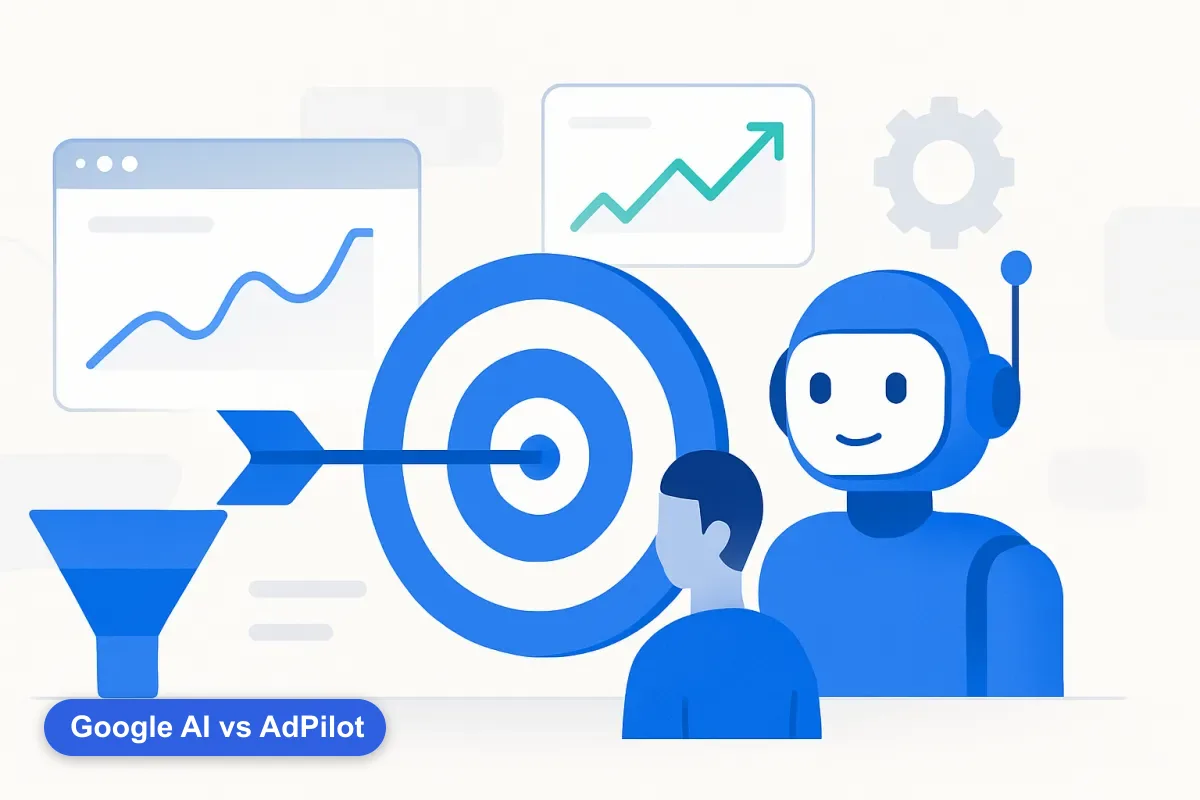
Google Ads AI automation is genuinely good at what Google measures. Smart Bidding, the optimization score, and auto-applied recommendations mostly steer toward more spend and wider reach, which is also how Google books revenue. AdPilot is an independent agent tuned to one target you set, and every write waits for one-click approval.
Google's built-in AI is real, and good at real things
Google's machine learning is strong, and Smart Bidding is the clearest case. tCPA and tROAS set each individual auction bid off signals no human prices in real time — device, hour, the exact query, location, browsing history, thousands of small correlations. Managing keyword-level bids by hand across a few hundred terms is a losing game; hand it to the algorithm.
Performance Max earns its keep in places too: one budget across Search, Shopping, Display, YouTube and Gmail, surfacing conversions a Search-only setup misses for some ecommerce accounts. Competence isn't the question. The target is: is the AI optimizing for you, or for Google? Sometimes both.
The incentive nobody prints on the dashboard
Google earns when you spend. That's the business model, not a scandal — but it shapes every nudge.
Read what the recommendations recommend: raise the budget, broaden keyword match, add Performance Max, switch on auto-apply, lift your tCPA target so the algorithm has 'more room.' Each is defensible alone; nearly all point one way — more spend, more impressions, more auction share. The panel rarely says cut a budget, add negative keywords, tighten match types, or pause a campaign that's bleeding, even when that's the fix.
The optimization score looks like a health grade out of 100%. It isn't. It's Google's estimate of how well your account is 'set to perform,' and you raise it mainly by applying the recommendations Google surfaces (or formally dismissing them). A lean, profitable account can sit at 78% because you declined a few 'raise budget' prompts that would have wrecked your margin. Score and P&L measure different things; the interface blurs them.
Note
This isn't bad faith, it's structure: a platform paid per click surfaces advice that trends toward more clicks. You want someone in the room whose paycheck doesn't move when your budget does.
Concrete case: a campaign converts fine but the optimization score sits at 82%. The panel suggests +20% budget and moving a few exact-match keywords to broad match to 'capture more conversions.' Apply both and reach climbs — so does the bill, and in come loosely related search terms that browse and never buy. Nothing broke. You spent more to confirm what you knew, with no second opinion tuned to your margin. That's the gap AdPilot fills.
Line the incentives up: Google's AI is rewarded when spend rises; AdPilot when your goal is hit. Everything else follows from that.
Google's built-in AI
More spend, more impressions, more auction share
AdPilot
Hitting your target CPA or ROAS
Google's built-in AI
Google — that spend is its ad revenue
AdPilot
No one. The price is flat at any spend level
Google's built-in AI
“Raise your budget,” “broaden your match,” “turn on auto-apply”
AdPilot
“Cut this wasted spend,” “tighten this campaign”
Google's built-in AI
Up
AdPilot
Down, wherever it's being wasted
Google's built-in AI
A higher optimization score
AdPilot
Your profit, proven before vs. after
Google's built-in AI
The platform selling you the ads
AdPilot
You, the advertiser paying for them
Google's built-in AI
Sells the ads and grades them
AdPilot
Independent — sells no ad space
Google's built-in AI
Auto-apply can change it unasked
AdPilot
Only you, via one-click approval
Google's built-in AI
Rarely prompts a cut or a pause
AdPilot
Actively hunts wasted spend to trim
Google's built-in AI
Your ad spend — uncapped, per click
AdPilot
Flat $99–$249/mo at any spend
Google's built-in AI
Incentive never shown on the dashboard
AdPilot
Independence stated up front
Google's built-in AI
Declining prompts dents your score
AdPilot
Reject a proposal — nothing changes, no penalty
| What drives it | Google's built-in AI | AdPilot |
|---|---|---|
| What it's rewarded for | More spend, more impressions, more auction share | Hitting your target CPA or ROAS |
| Who gains when you spend more | Google — that spend is its ad revenue | No one. The price is flat at any spend level |
| The nudge it tends to push | “Raise your budget,” “broaden your match,” “turn on auto-apply” | “Cut this wasted spend,” “tighten this campaign” |
| Which way it pushes your spend | Up | Down, wherever it's being wasted |
| What counts as success | A higher optimization score | Your profit, proven before vs. after |
| Whose side it's on | The platform selling you the ads | You, the advertiser paying for them |
| Conflict of interest | Sells the ads and grades them | Independent — sells no ad space |
| Who can change your account | Auto-apply can change it unasked | Only you, via one-click approval |
| Bias toward cutting waste | Rarely prompts a cut or a pause | Actively hunts wasted spend to trim |
| What its price tracks | Your ad spend — uncapped, per click | Flat $99–$249/mo at any spend |
| Transparency of its motive | Incentive never shown on the dashboard | Independence stated up front |
| Cost of saying no | Declining prompts dents your score | Reject a proposal — nothing changes, no penalty |
A suggestion is not follow-through
The second problem grates more day to day. Google's recommendations are suggestions buried in a complex tool — nobody executes them for you, and nothing proves them out after.
'Add broad match keywords to capture more traffic.' Which ones, at what bid, with which negative keywords so it doesn't burn budget on junk queries? Restructure the ad group or dump them in? You interpret the suggestion, judge it against your goal, configure it, and then — the part that sinks small advertisers — get no clean before/after on that one edit. Traffic moved; ten other things moved too. Helped or hurt? The interface won't say, so you guess or dig through segmented reports you never learned.
That closed loop is AdPilot. You state a goal in plain words; the agent reads the account and proposes one concrete change; you approve; a metric snapshot saves before it executes; a daily pull keeps tracking the account; a before/after view shows what moved — CPA, ROAS, CTR, cost, conversions — after that specific edit. Your next decision leans on the last one instead of a hunch. One worked before/after is on the worked-example page: a single case, not a promise of typical results.
The interface assumes you already speak PPC
Google Ads assumes the vocabulary: impression share, tCPA, match types, asset groups, conversion value rules, the split between a Search campaign and the Search partner network. Run a five-person shop where Ads is one of nine jobs before lunch and the interface is a wall.
The automations slide the wall sideways, not down. Turning on Performance Max still means grasping what you handed over and what visibility you lost. Auto-applied recommendations edit your account while you look elsewhere — an odd thing to accept on the budget line. For a non-specialist, 'the AI handles it' becomes 'I no longer know what my account is doing.'
Where AdPilot fits — and where it deliberately doesn't
AdPilot runs alongside Google's tools, not against them. Smart Bidding stays on; your campaigns keep serving. AdPilot adds an independent layer with one objective — the goal you typed, 'lower my CPA' or 'make my Shopping campaigns more efficient' — inside hard limits.
- Every write — budget, bid, keyword, ad — arrives as a plain-language proposal card. Nothing changes until you click approve.
- Campaign deletions are off the table, and shared budgets are never touched.
- A snapshot is saved before every change, so each one has a clean before/after record.
- Every action lands in an audit log — who, what, when, old value → new value — and can be reverted with one click.
The honest trade-off: AdPilot runs slower than autopilot, on purpose — you read proposals and click. Want a system that changes things without asking? This isn't it and won't become it; the approval step is the point when it's your own money. Weighing software against hiring help? The piece on an agency versus AI automation runs that math. Comparing tools in the category? The rundown of Google Ads automation tools covers the field.
Side by side, the split is concrete: Google's AI is strong at bidding but won't build your campaigns or prove a change worked after. The table maps where its automation stops and AdPilot's starts.
Google's built-in AI
No. You create and configure everything yourself
AdPilot
Drafts each change for you; you approve it
Google's built-in AI
Only for bidding. Its recommendations are prompts you still apply by hand
AdPilot
No, by design. Every change waits for your one-click approval
Google's built-in AI
No. You translate the goal into settings yourself
AdPilot
Yes. Say “lower my CPA” and the agent drafts the change
Google's built-in AI
A terse recommendation with little context
AdPilot
Every proposal shows the numbers that led to it
Google's built-in AI
Complex dashboard, heavy PPC jargon
AdPilot
Plain-language chat, no jargon
Google's built-in AI
Hours of setup and learning the interface
AdPilot
One-click Google connect, answers in minutes
Google's built-in AI
You set them, and they're easy to miss
AdPilot
No deletes, snapshots, one-click revert
Google's built-in AI
Rarely; recommendations lean toward more spend
AdPilot
Proposes cuts wherever spend is wasted
Google's built-in AI
Not built in
AdPilot
Snapshot saved, before/after tracked
Google's built-in AI
You check the dashboards yourself
AdPilot
Daily metric pull, tracked against your goal
Google's built-in AI
One account at a time; no unified view
AdPilot
Up to 10 accounts in one dashboard
Google's built-in AI
No single log; changes are hard to retrace
AdPilot
Full audit log (old → new), every change reversible
Google's built-in AI
Free, but tuned to grow your ad spend
AdPilot
Flat $99/$249 at any ad spend
| Capability | Google's built-in AI | AdPilot |
|---|---|---|
| Builds & sets up campaigns for you | No. You create and configure everything yourself | Drafts each change for you; you approve it |
| Runs on full autopilot | Only for bidding. Its recommendations are prompts you still apply by hand | No, by design. Every change waits for your one-click approval |
| Turns a plain-language goal into changes | No. You translate the goal into settings yourself | Yes. Say “lower my CPA” and the agent drafts the change |
| Explains the reasoning behind a change | A terse recommendation with little context | Every proposal shows the numbers that led to it |
| Ease of use | Complex dashboard, heavy PPC jargon | Plain-language chat, no jargon |
| Time to first useful insight | Hours of setup and learning the interface | One-click Google connect, answers in minutes |
| Guardrails on spend | You set them, and they're easy to miss | No deletes, snapshots, one-click revert |
| Flags wasted spend to cut | Rarely; recommendations lean toward more spend | Proposes cuts wherever spend is wasted |
| Before/after proof of each change | Not built in | Snapshot saved, before/after tracked |
| Daily performance tracking | You check the dashboards yourself | Daily metric pull, tracked against your goal |
| Manages multiple accounts | One account at a time; no unified view | Up to 10 accounts in one dashboard |
| Undo & audit trail | No single log; changes are hard to retrace | Full audit log (old → new), every change reversible |
| What it costs to run | Free, but tuned to grow your ad spend | Flat $99/$249 at any ad spend |
What it costs to have a second opinion
A free 7-day trial connects one Google Ads account with the core features and full approval flow, so you can read proposals against your own numbers before paying a cent. Growth is $99/month for more AI usage, daily performance tracking, and full before/after history. Pro is $249/month for up to ten accounts and higher limits. It's usage-based — you pay for what the assistant actually uses, not a retainer. Full breakdown on the pricing page.
Outside help usually means an agency retainer plus a slice of your ad spend — a recurring cost that climbs as you scale. Category pricing moves around, so check current numbers before you commit. A free 7-day trial that shows exact proposals is a low-risk way to test the idea against your own account.
Connect in one click from the dashboard — no API keys, no setup. AdPilot is in early access, with limited spots while our app finishes Google's verification — but changes you approve are written to your live account for real, and you see exactly what each one does before it runs, because the whole design rests on showing what's happening rather than hiding it.
Key point
Google's AI is powerful and tuned to Google's meter. AdPilot watches yours: it proposes, you decide, and every change carries a before/after you can actually read.
Frequently asked questions
Is Google Ads AI good for a small business?
What is the Google Ads optimization score really measuring?
Should I turn on auto-applied recommendations?
Does AdPilot replace Google's Smart Bidding or Performance Max?
How is AdPilot different from Google's own recommendations?
Is AdPilot affiliated with Google?
What does AdPilot cost to try?
Keep reading
How to See What Your Competitors Are Advertising on Google
Google publishes every ad from every verified advertiser in a public database. Most small advertisers have never heard of it. Here is how to read it, what it will not tell you, and what to do with what you find.

Running Google Ads Without an Agency: A Weekly System That Works
Read the search terms report, check pacing against target CPA, make one or two small changes, measure. Here's the weekly loop that runs a healthy account without a retainer.