
Google Ads agency vs AI copilot: which should a small business use?
Agency retainer plus a cut of your ad spend, or a flat AI copilot that proposes every budget, bid, and keyword edit for your one-click approval. Where each actually wins.
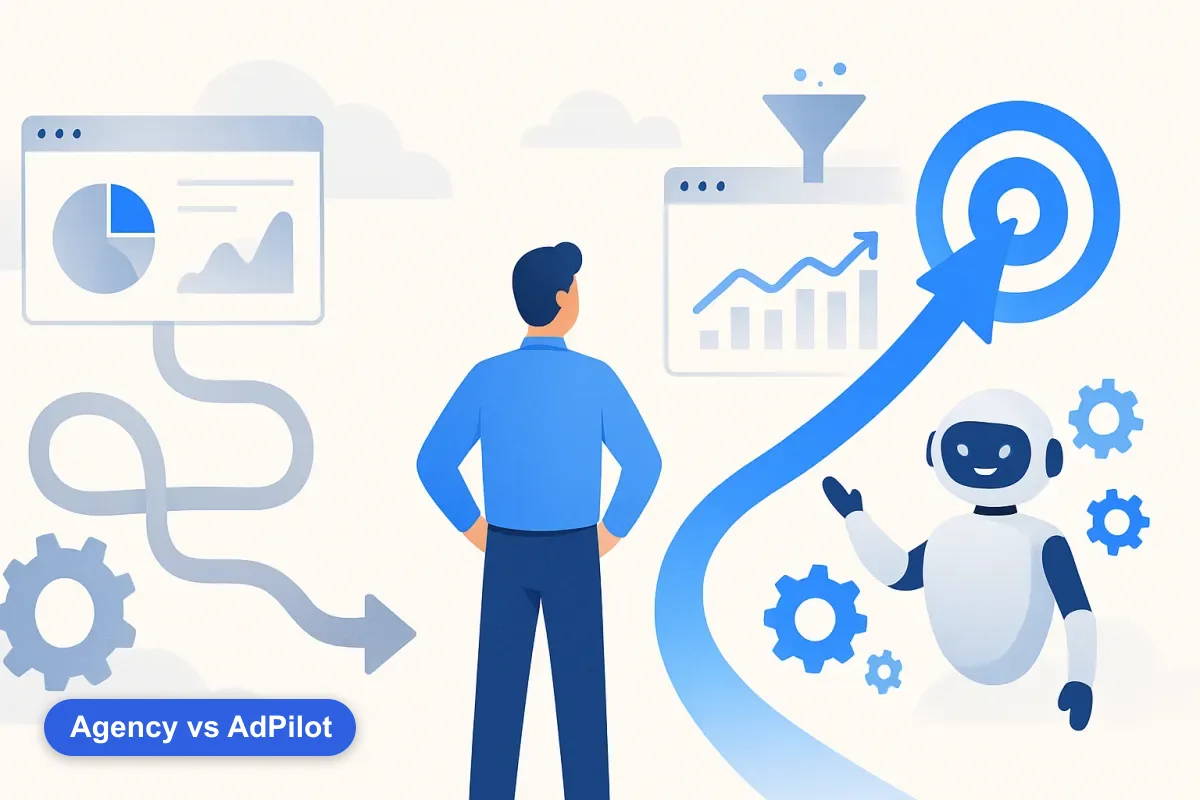
The best Google Ads agency alternative for a small business is an AI copilot you steer yourself. AdPilot reads your account, drafts specific edits, and applies each one only after your one click. Agency-style optimization, full account ownership, a flat monthly price instead of a retainer plus a percentage of your ad spend.
Either route can run your account well. What actually decides it: how fast a change goes live, what you pay as your budget grows, and how much of the steering wheel you keep.
The two ways to run Google Ads without doing it yourself
Hire a shop to sit in the account, or use AI management software that does the analysis and drafts the changes while you keep the final say. Both work. They break differently and hit your wallet differently.
Speed: monthly cycles versus this afternoon
An agency runs your account on its calendar. You email a request; it queues behind a dozen other accounts; someone reviews it during business hours, maybe next Tuesday; the edit goes live days later and shows up in next month's report. By then the broad-match search term that spiked your cost has already burned through the budget.
Fine for a brand spending six figures where nothing moves overnight. On a $2,000 budget, three lost days is real money.
With a copilot you type the goal in plain words — „my cost per conversion crept up this week, find out why.“ The agent pulls the account, sorts the search terms report by cost, spots the broad-match keyword eating spend with zero conversions, and hands back a proposal in seconds: add it as a negative, or cap the budget. You approve, the change applies, and a snapshot of the before numbers saves the instant you click.
This isn't software out-thinking a good strategist. It's the gap between spotting a problem and fixing it collapsing from weeks to minutes, because there's no queue and no office hours in the way.
What Google Ads management actually costs
Agencies and freelancers bill some blend of a monthly retainer, a percentage of ad spend, and an upfront setup fee, often on a minimum contract term. Figures vary by market, but the percentage-of-spend piece is the one that bites: your management bill climbs every time you scale the budget.
That percentage sets up a quiet conflict. If your agency earns a cut of everything you spend, trimming wasted budget trims their fee. Plenty of agencies are straight with you, but the math pulls the wrong way and you're trusting them to act against their own invoice.
A flat subscription removes that. AdPilot costs the same whether you spend $500 or $50,000, so finding the waste is the whole job, not a threat to the fee. A free 7-day trial with the full approval flow, then Growth at $99/month with more AI usage and daily tracking, or Pro at $249/month for up to ten accounts. You pay for what the assistant uses, not a share of your media.
Scale from $2,000 to $8,000 a month because the campaigns are working, and a percentage fee quadruples with you. The AdPilot bill doesn't move. Over a year the gap can dwarf the subscription itself.
Agency / freelancer
Retainer + % of ad spend + setup fee
AdPilot
Flat monthly ($0 trial / $99 / $249)
Agency / freelancer
Days to weeks, business hours
AdPilot
Minutes, on demand
Agency / freelancer
Fee often grows with your budget
AdPilot
Same price at any spend
Agency / freelancer
Often a junior across many accounts
AdPilot
AI agent, reviewed by you
Agency / freelancer
You hand it off
AdPilot
You approve every change
Agency / freelancer
Minimum contracts common
AdPilot
Cancel anytime, no lock-in
Agency / freelancer
Often in agency's manager account
AdPilot
Stays in your own account
Agency / freelancer
Access handoff, onboarding calls
AdPilot
One-click Google OAuth, no API keys
Agency / freelancer
Monthly report, weeks stale
AdPilot
Daily pull, before/after dashboard
Agency / freelancer
Recapped in a slide deck
AdPilot
Full log: who, what, when, old to new
Agency / freelancer
Changes rarely snapshotted
AdPilot
Snapshot before each change, reversible
Agency / freelancer
Vary by who you hire
AdPilot
No deletes, snapshots, one-click revert
Agency / freelancer
Each account adds fees
AdPilot
Up to 10 accounts on Pro
Agency / freelancer
Stays a black box to you
AdPilot
Every proposal explained plainly
| Factor | Agency / freelancer | AdPilot |
|---|---|---|
| Cost model | Retainer + % of ad spend + setup fee | Flat monthly ($0 trial / $99 / $249) |
| Turnaround | Days to weeks, business hours | Minutes, on demand |
| Incentive on spend | Fee often grows with your budget | Same price at any spend |
| Who does the work | Often a junior across many accounts | AI agent, reviewed by you |
| Control | You hand it off | You approve every change |
| Commitment | Minimum contracts common | Cancel anytime, no lock-in |
| Account ownership | Often in agency's manager account | Stays in your own account |
| Setup | Access handoff, onboarding calls | One-click Google OAuth, no API keys |
| Reporting | Monthly report, weeks stale | Daily pull, before/after dashboard |
| Audit trail | Recapped in a slide deck | Full log: who, what, when, old to new |
| Reversibility | Changes rarely snapshotted | Snapshot before each change, reversible |
| Safety guardrails | Vary by who you hire | No deletes, snapshots, one-click revert |
| Multiple accounts | Each account adds fees | Up to 10 accounts on Pro |
| Understanding your account | Stays a black box to you | Every proposal explained plainly |
Who actually touches your account
At the premium end you get a senior strategist who learns your business. At the cheap end, where most small budgets land, your account is one of many a single account manager juggles. A low retainer buys a checklist pass — a scan of optimization score and a few negative keywords — not deep thought. That's the economics, not a knock on the person.
A copilot reads your account at the same depth every time, biggest or smallest of the day, no fatigue and no hours to run out of. You read the reasoning and make the call, so nothing runs on autopilot behind your back.
Transparency, ownership, and the approval flow
Hand an account to an agency and changes just appear; the why turns up in a monthly deck, if at all. Sometimes the campaigns and conversion tracking live inside the agency's own manager account, and prying them loose when you leave is its own project.
AdPilot runs the other way. Every write — a budget tweak, a bid change, a new negative keyword, a paused ad — arrives as a proposal card with the old and new values side by side. Nothing moves until you approve, and one click is the whole ceremony. Guardrails sit on top: campaigns can't be deleted, shared budgets are never touched, and every applied change is snapshotted first so you can revert it with one click.
You keep the keys
The account stays yours. AdPilot connects through Google's own OAuth in one click — no API keys, no technical setup — and refresh tokens are stored AES-256 encrypted. No lock-in, no minimum term. Disconnect whenever you want and everything you built is still sitting in your own Google Ads account.
Every action lands in an audit log: who, what, when, old value, new value. A snapshot saves before each executed change and a daily pull tracks the numbers, so the before/after dashboard shows each edit's real effect on CPA, ROAS, CTR, cost, and conversions. One worked before/after example lays it out end to end.
Straight about the beta
AdPilot is in early access, with limited spots while our app finishes Google's verification. The analysis, proposals, snapshots, approval flow and Revert are all real, and every change you approve is written to your live account for real. Better you hear the exact status from me now than wonder later.
You don't need to be technical
The Google Ads interface scares off plenty of owners: tCPA, optimization score, match types, Performance Max, quality score, impression share, a wall of jargon. Part of what an agency sells is „you don't have to understand this.“
A copilot hands you that relief without the handoff. You describe what you want in normal words; the agent turns the account's mess into a plain-language recommendation with the reasoning attached. Because every proposal explains itself, a few weeks in you actually start to understand your own account — something no retainer hands you.
When an agency still wins
Software doesn't take every round. Real cases where hiring people is the right call:
- Big budgets. Past a certain spend, a percentage fee buys senior human strategy that pays for itself, and the stakes justify a dedicated person.
- Creative work. Agencies write ad copy, shoot video, design landing pages, build shopping feeds. A copilot proposes account changes; it won't produce your creative.
- Full-funnel or multi-channel. Stitching Google, Meta, email, and offline into one strategy is where a human team earns its money.
- You truly want it off your plate. Some owners never want to click approve and would rather forget the account exists. That's exactly what an agency sells.
If that's you, hire well and hold them to the numbers - and go in knowing what your own trade's account looks like first, whether that is home services, lawyers or ecommerce.
The honest version
For a small business with no agency budget and no PPC background, the default has moved. You get in-the-moment optimization, full ownership, an audit trail, and a flat price, instead of a retainer that scales with spend and a junior who half-remembers your account. If you're spending big or need creative and cross-channel strategy, hire an agency. If you mostly want the account watched, tightened, and explained back to you, a copilot covers it for a fraction of the cost.
For more on the tooling side, I've weighed Google's built-in automation against a dedicated copilot and how the main Google Ads automation tools stack up.
Or skip ahead: start the free 7-day trial, connect one account, and see what the agent flags in the first ten minutes. Browse the plans here.
Frequently asked questions
What is the best Google Ads agency alternative for a small business?
How much does Google Ads management usually cost?
Do I need a Google Ads agency, or can I manage without one?
Is AI Google Ads management safe to trust with my account?
Will an agency have an incentive to lower my ad spend?
Do I keep control of my Google Ads account with AdPilot?
How fast can an AI copilot make changes compared to an agency?
Keep reading
How to See What Your Competitors Are Advertising on Google
Google publishes every ad from every verified advertiser in a public database. Most small advertisers have never heard of it. Here is how to read it, what it will not tell you, and what to do with what you find.
Running Google Ads Without an Agency: A Weekly System That Works
Read the search terms report, check pacing against target CPA, make one or two small changes, measure. Here's the weekly loop that runs a healthy account without a retainer.